

Subreddits (Reddit Communities)
Reddit has niche communities where tech enthusiasts gather. By sharing your startup on relevant subreddits, you can reach people interested in AI and robotics. Always check each subreddit’s rules before posting, as many have strict policies on self-promotion. Here are some key subreddits:
r/MachineLearning – Premier machine learning subreddit (~3+ million members) focused on ML research, projects, and news. Direct promotional posts are not allowed on the main feed. Instead, mods provide a weekly “[D] Self-Promotion Thread” for personal projects, startups, etc.aiexpert.network. You should post your startup there, including details and perhaps a question to invite discussion. Outside the promo thread, you may share project updates (tagged
[P]) if they contribute value (e.g. releasing open-source code). Etiquette: Be transparent that it’s your project and don’t spam. Engage with any feedback in comments. Link: reddit.com/r/MachineLearning – look for the latest “Self-Promotion” sticky thread.r/artificial (Artificial Intelligence) – Largest general AI subreddit (1M+ members) covering AI news, research, and startups. Self-promotion is permitted sparingly under a strict “10% rule” (no more than ~10% of your posts/comments should be self-promotional)reddit.com. In practice, this means you should be an active, helpful community member before plugging your startup. Pure ads or link-drops will likely be removed. Etiquette: Share your startup only if it’s genuinely interesting to AI folks (e.g. a new open-source tool or a compelling use-case) and frame it as “here’s something we built, would love feedback,” rather than a sales pitch. Link: reddit.com/r/artificial.
r/robotics – Community of robotics enthusiasts (from hobbyists to professionals). It’s common to share personal robotics projects, demos, and news here. Self-promotion policy: Moderation is lighter if your post is on-topic and showcases tech or asks for feedback (avoid blatant marketing). Often, project posts are tagged as
[Project]or similar. The subreddit occasionally hosts “Showcase” threads for community projects. Etiquette: When posting your robot or AI-driven hardware, include photos/videos and technical details. Emphasize what’s interesting (e.g. “Built a warehouse robot that uses AI for navigation – here’s a demo, let me know what you think!”). This invites discussion. Link: reddit.com/r/robotics (you can create a new post, just ensure it’s informative).r/startups – Large subreddit (1.8M members) for startup advice and sharing. No direct ads allowed on the main subreddit; instead they have a weekly “Share Your Startup” thread (usually pinned to the top) where founders can post a blurb about their startupnotifier.so. They also run weekly threads for feedback and specific topics. Etiquette: Only post your startup in those dedicated threads. Keep your blurb concise: explain what your startup does and include a clear ask (e.g. “looking for beta users” or “feedback welcome”). Engage by responding to any Redditors who comment on your share. Outside of those threads, you can ask startup-related questions on r/startups, but frame them generically (e.g. “How do I validate market X?” rather than “Please download my app”). Link: reddit.com/r/startups (check for Weekly “Share Your Startup” post).
Posting Tips: On Reddit, timing matters less than relevance and authenticity. Ensure you contribute positively to the community (answer others’ questions, join discussions) before and after promoting your own project – users check your history. When you do share, be straightforward about being a founder, and invite feedback or discussion. This transforms a self-promo into a community conversation, which is much better received.
Tech Newsletters & Email Digests
Tech newsletters can broadcast your startup to thousands of readers. Many accept submissions or tips about cool new projects, especially in AI/robotics. It’s often best to craft a short email pitch to the editors. Here are a few to consider:
TLDR (Tech & Startups Newsletter) – A daily tech newsletter with byte-sized news and product highlights, read by a broad tech audience (engineers, founders, etc.). It often features interesting new tools or startups. While TLDR is curated, you can submit a story tip by emailing the team (or via their website form). Keep it very brief: one sentence on what your startup does and why it’s noteworthy. For example, mention a unique achievement (“Our drone startup just open-sourced a navigation algorithm”) or how it benefits the readers. Self-promotion policy: They are open to cool new tools (especially if free or open-source for readers to try). Alternatively, TLDR offers sponsorship slots where startups get a short feature – this is paid, but reaches ~1M+ readers (useful for launch). Link: tldr.tech – see the “Submit a link” or “Contact” page.
Benedict Evans’ Newsletter – A weekly email by analyst Benedict Evans (~200k subscribers) covering “what mattered in tech this week”ben-evans.com. The content is usually big-picture analysis, but he sometimes links to notable industry news or exemplary products. There’s no formal submission process, but if your startup has newsworthy impact (e.g. significant funding round, or a demo pushing technological boundaries), you could send him a polite note via his website or Twitter. Emphasize the trend or problem your startup illustrates rather than just “please feature us.” (E.g. “Hi Benedict, we built a robot that automates warehouse inventory – an interesting example of AI + logistics – thought you might find it relevant.”) Additionally, his newsletter accepts sponsorsben-evans.com, which is another route to get in front of his audience (mostly tech execs and VCs). Link: ben-evans.com (see “About & Contact” for email).
Tech and AI Digest Newsletters – Inside AI (from inside.com) and The Batch (deeplearning.ai’s weekly AI newsletter) are examples that focus on AI news and breakthroughs. These typically cover research and major product announcements. To get featured, frame your startup as news: e.g., publish a press release about a breakthrough or a funding announcement and send it as a tip. Inside AI has a tip submission form; The Batch might consider notable AI applications (especially if you have an academic angle or if an AI thought leader is involved). Link: inside.com/ai (has “Submit story” option).
Robotics-specific Newsletters – e.g. The Robot Report (industry newsletter/blog for robotics) and ROBO Global Newsletter. These cater to robotics professionals and investors. Getting a mention usually requires a press release or a significant milestone (product launch, patent, partnership). You can contact their editors with a brief news pitch. Ensure it’s factual and highlights why your robot is innovative. Etiquette: avoid hype; tie your news to industry trends the newsletter follows (e.g. automation in healthcare robots).
Newsletter Pitching Tips: Keep your email very concise – newsletter curators sift through many submissions. Include a clear subject line (e.g. “Tip: AI startup using drones for crop monitoring”). In 2-3 sentences, cover: what your startup does, the news/hook (launch, new feature, etc.), and a link (press kit or blog post). Example: “Hi, I’d like to share FarmAI – a new startup using drones + AI to scan crops for disease. It’s like a ‘doctor for plants’, using computer vision to alert farmers early. We just opened our beta (free for farmers). If you find this interesting for TLDR, you can check it out: [link]. Thanks!” Align your tone with the newsletter’s style (informative, not overly salesy). Finally, be mindful of timing: send your pitch a few days before the newsletter’s issue is compiled (many weekly ones are finalized on weekends or Monday for a Tuesday send-out).
Product & Startup Launch Platforms
Launching on dedicated platforms can dramatically increase your visibility among early adopters, investors, and the press. Each platform has its own submission process and community norms. Here are the main ones:
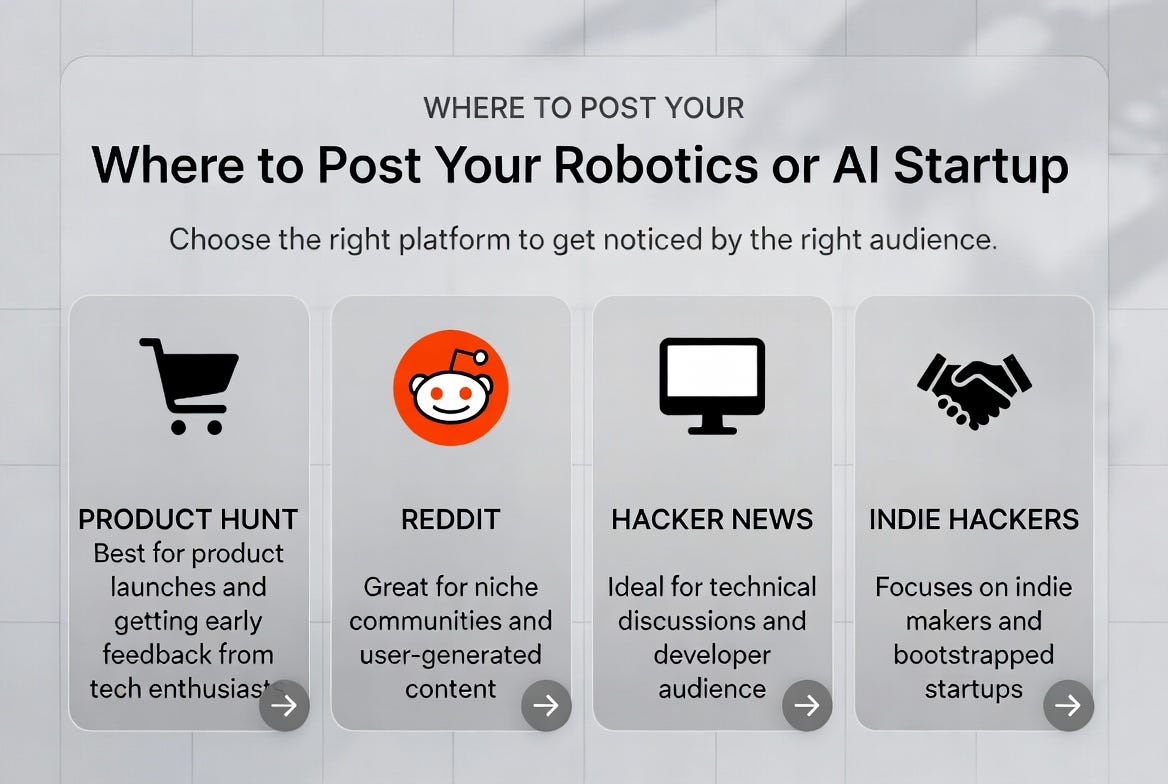
Product Hunt – The go-to platform for launching tech products. You create a listing (product name, tagline, images/media, and a first comment). The community of tech enthusiasts will upvote and comment. Posting rules/etiquette: Don’t explicitly ask for upvotes (on or off the platform) – Product Hunt penalizes thatproducthunt.com. Instead, in your maker comment, tell your story: why you built this, key features, and invite feedback (“Please let us know what you think” or “Would love your feedback!”). Be responsive on launch day: reply to every comment, thank people, and answer questions. Ideal timing: Launch at 12:01 AM Pacific Time to get a full day of exposureproducthunt.com. Tuesdays, Wednesdays, or Thursdays tend to have higher traffic (Mon can work too), but avoid major holidays or big competing launches. Link: producthunt.com – use the “Ship” or “Launch” feature to schedule your post if needed. Pro tip: Engage with the PH community before launching (follow others, comment on products) so you’re not posting in a vacuum.
BetaList – A platform featuring pre-launch or early-stage startups to an audience of early adopters. Founders use it to gather beta users or mailing list signups. Submission process: You fill out a form with your startup name, one-liner, description, and link. There’s often a queue (free submission can take weeks; they offer paid expedited options). Posting rules: Your product should be new and not previously featuredbetalist.com. BetaList specifically wants tech startups (software or hardware) with either a coming-soon page or a recently launched betabetalist.com. Make sure you have a decent landing page – they require that it not be a generic template and that users can sign up or request accessbetalist.com. Etiquette: BetaList readers expect to be “early access” users, so consider offering them something (e.g. immediate invite, or a small discount) and mention it in your listing. Ideal timing: No specific day – but do it as early as possible in your launch cycle to start building an email list. BetaList will email you if you get featured. Link: betalist.com/submit (ensure you follow their guidelines to avoid rejection).
Alternative Startup Directories – There are many other listing sites: BetaPage, Startup Buffer, Launching Next, KillerStartups, etc. These typically allow you to submit a short description of your startup. They vary in impact (often smaller audiences than Product Hunt or BetaList), but listing on them can boost your SEO and snag a few early users. Example: BetaPage is a community where new startups are upvoted (like a mini Product Hunt); Startup Buffer and Launching Next showcase “startup of the day” on their site/newsletter. Posting rules: Generally straightforward – fill out a form with your info. Many have free and paid options. Etiquette: Use your one-liner effectively to entice readers (“X is like Uber for Y”) and ensure your website is ready for any traffic. Ideal timing: Whenever – just be sure the info is up-to-date and that you’re ready to handle sign-ups or inquiries.
Product Launch Communities – Outside official platforms, consider communities like Showcase pages or threads. For example, some tech forums (and subreddits like r/SideProject or r/InternetIsBeautiful) allow sharing new products. r/InternetIsBeautiful (16M members) specifically allows posting genuinely useful or unique websites – if your startup has a consumer-facing web app or demo, you can post there (just don’t oversell; let the product speak for itself). Hacker News (Show HN) is another (see Forums below). These aren’t “profiles” to create, but one-time launch posts that can drive significant traffic.
Launch Platform Tips: Prepare your materials in advance – screenshots, a promo video/gif, a crisp tagline, and a paragraph pitch. Consistency matters: you might use the same tagline across PH, BetaList, etc., but tailor the extended description to the audience. For instance, Product Hunt can be a bit playful or emoji-friendly in maker comments, whereas BetaList is more utilitarian (just what it is, and link to sign up). Also, if you get featured on one platform, leverage it on others (e.g., “#1 Product of the Day on Product Hunt” is social proof you can mention later on your website or in emails).
Online Forums & Communities
Beyond social media and launch sites, there are independent communities and forums where startup founders and tech professionals congregate. Participating in these can help you build an audience and get feedback. Tailor your approach to each community’s culture:
Hacker News (Show HN) – An extremely influential tech forum (run by Y Combinator) where developers and founders share projects. Posts reach a highly technical audience. To promote your startup here, make a post titled “Show HN: [Your Product Name] – [One-line description]” when you have something launch-ready. In the post text, introduce your startup like speaking to peers: explain the problem you solve, how you built it, and avoid any marketing fluff (“HN will ignore anything that reads like an ad or PR”news.ycombinator.comdev.to). For example, mention the tech stack or a challenge you overcame – HN users love technical detail. Posting rules: Don’t ask people to visit or upvote in the title or comments. Also, no link stuffing – provide your product’s URL in the submission form and perhaps once in text if needed. HN’s guidelines explicitly forbid vote manipulation and overly promotional language. Etiquette: Stay around to answer questions! Engage politely with feedback or criticism; HN commenters can be frank. If someone is wrong about your product, respond with insight rather than defensiveness. Ideal timing: Many suggest posting in the morning US time on a weekday (to catch Silicon Valley and East Coast users) – roughly between 9 AM and 12 PM Pacificdev.to. However, great content can catch fire anytime. If your first post doesn’t get traction, HN allows re-submitting later (ideally with improvements) – just don’t spam it repeatedly.
Indie Hackers – A forum and community for entrepreneurs, particularly those building bootstrapped startups and “building in public.” You can create a product page on IH and post updates (milestones, revenue figures, etc.), as well as participate in the forum discussions. Posting suggestions: Write an introductory post in the “Products” or “Launches” category detailing your journey or a milestone (e.g. “Launched my AI SaaS – here’s what I learned in 3 months of development.”). The tone should be conversational and honest – share both challenges and wins. Self-promotion is welcome as long as it comes with personal insights or questions for the community. For instance, instead of just “Check out our robot!”, you might post “We built a warehouse robot that cuts inventory counting time in half. AMA about the tech or our go-to-market – would love your feedback!” This invites engagement. Etiquette: Be supportive of others (comment on their posts, offer help). If you’re not an active member and just drop your launch post, it may get little attentionreddit.com. So try to build some presence. Also, IH has a “no trolling/harassment” policy – keep it positive and transparent. Ideal timing: IH has global users, but many posts do well in late afternoons U.S. time and weekends when founders are catching up on forums.
AI Alignment Forum (and LessWrong) – A specialized forum for AI researchers and theorists (focused on AI safety, ethics, and alignment). This is not a place for product promotion in the usual sense. However, if your startup directly contributes to AI safety or you’ve written a technical paper/blog post about your approach, you could share that here to spark discussion. Posting rules: Posts are expected to have research value – e.g., a deep dive into your algorithm or a critique of AI approaches. Simple product announcements will be downvoted or removed. New users can post on LessWrong (the broader rationalist community) and if the content is strong, it might be cross-posted or promoted to the Alignment Forum by moderatorslesswrong.com. Etiquette: Extremely high standards – be prepared for insightful, sometimes tough, feedback. Don’t use marketing speak; use academic tone. Use this channel only if your startup’s mission aligns with advanced AI topics (for example, you’re working on explainable AI or a safety-critical robotic system and you want input on your methods).
Other Niche Forums: Depending on your startup, there might be relevant communities: e.g. Robot Operating System (ROS) Discourse for ROS-based robots, Arduino Forums if you have a hardware DIY angle, or Kaggle Forums if it’s ML-heavy and you’re sharing a challenge/dataset. When posting in such places, focus on the technical aspects and community benefit (perhaps release a library or ask for testers). Always read the room – if the forum explicitly bans self-promo, find a way to share value (like a tutorial that incidentally uses your product, with disclosure).
Slack/Discord Communities & Professional Groups
Private communities on Slack and Discord, as well as groups on LinkedIn and Facebook, can be excellent for targeted promotion. The audiences here tend to be smaller but highly engaged. Always follow community rules – many have specific channels or days for promotions.
“Startup Chat” Slack – A large invite-only Slack community for startup founders (with channels for #advice, #jobs, #feedback, etc.). Posting rules: Some startup Slacks require you to introduce yourself first in an #introductions channel. Do that – share who you are and what you’re working on (without a hard sell). For promotion, see if there’s a dedicated channel (many have something like
#shameless-plugsor#launch). In that channel, you can post about your startup. Keep it short and engaging: explain the problem you solve and include a call-to-action (“We just opened our beta – would love for this community to try it out!”). Because it’s a chat, people may respond with thread comments – be ready to answer questions. Etiquette: Don’t DM people unsolicited links; also, remain active in other conversations (Slack communities quickly flag drive-by promoters). Link: (You typically need to apply or get an invite via the community’s website. For Startup Chat, it’s a paid membership in some casesstartups.comspringworks.in.)Discord Communities (AI & Robotics) – Discord has many public servers for tech topics:
Learn AI Together (Discord) – ~80k members interested in AI development, from newbies to researchers. It has channels like #daily-news, #projects, #questions. You can share your project in a project showcase channel. Etiquette: Provide context (e.g. “Built an AI tool that <does X>. It’s free to test – would love feedback!”). Don’t just drop a link; start a conversation around it. The community is supportive if you’re genuine.digitalocean.com
Robotix or Open Robotics Discord – communities for robotics developers (Robotix.io’s Discord is noted as very activereddit.com). Here you might find channels for specific interests (drones, ROS, 3D printing robots, etc.). Post in the relevant one. Etiquette: Engineers here appreciate technical details. For example, share a quick spec of your robot or an obstacle you overcame, along with a demo link. This invites peers to discuss or even help.
Indie Hackers Discord – (unofficial, since IH is primarily a forum, but there are founder-driven Discords out there like “Indie Worldwide” etc.) – If you join one, treat it like Slack: introduce yourself, engage, and only then mention your startup in the allowed context.
LinkedIn Groups – LinkedIn hosts groups such as “Future Technology & Artificial Intelligence” (260k+ members) or regional startup groups. Posts here appear in a feed for group members. Posting rules: Usually no blatant ads. A good strategy is to share an insightful post about your startup’s domain. For example, in an AI group, you might post: “AI in healthcare is notoriously hard – we’ve spent 6 months building a tool that scans X-rays for anomalies. It’s 2x faster thanks to [technique]. Curious to get your thoughts on this approach!” and then in comments or at the end mention, “(This is actually our startup, [Name], now enrolling beta users – DM if interested.)”. This way, you’re starting a discussion rather than just promoting. Etiquette: Professional tone, no memes or slang as you might on Reddit. Engage with any comments promptly (LinkedIn group posts can sometimes get comments days or weeks later due to the algorithm). Also, posting during business hours (Tue-Thu, 9am-1pm in the group’s predominant time zone) tends to get better visibility. Link: (Find groups via LinkedIn search; join and read rules on the group page before posting.)
Facebook Groups – There are numerous Facebook groups like “Artificial Intelligence and AI Robotics” or “AI Startups” (some local, some global). These can have anywhere from a few hundred to tens of thousands of members. Posting rules: Almost all FB groups have a rules section – read it. Many forbid “self-promotion” except in specific weekly threads or with admin permission. Some groups do “Promo Friday” where you can post your business. If promotion is allowed, treat the post like a story: include an image or video (visuals drastically increase engagement on FB). For instance, post a short clip of your robot in action with a caption explaining what it does and a polite ask (“We’ve been working on this for a year – finally ready to show the world. Would love feedback from this group!”). Etiquette: Be ready for comments – respond to each, as Facebook’s algorithm will show your post to more people if it’s getting engagement. Time-wise, evenings and weekends often get more traction in hobbyist/enthusiast groups (people browse off-work hours).
Special Interest Chat Groups – e.g. Slack channels for robotics startups (if you find one via communities like Hardware Herd or IoT communities) or Discords like r/entrepreneur’s Discord server. In any small community like this, the key is to give before you take: answer questions, join discussions, and build goodwill. Then when you announce your own project, people will be more receptive.
In summary, adjust your tone and content to the community: more technical in developer circles, more story-driven in founder circles, and more straightforward in professional groups. Always follow the specific posting rules (many groups have a pinned message or description with their do’s and don’ts). When in doubt, reach out to a mod/admin – a polite message asking “Would it be okay if I share my startup? It does XYZ, which I think the group would find useful” can go a long way and prevent your post from being removed.
Example Promotional Posts (Copy-Paste Templates)
Below are sample post templates for each channel type. You can adapt these to your own startup. They demonstrate a concise, engaging style with a clear description and call-to-action:
1. Forum Example (Hacker News – “Show HN” post)
Title: Show HN: RoboScan – AI-powered warehouse robot that audits inventory overnight

Hi HN! My co-founder and I built **RoboScan**, an autonomous warehouse robot that uses computer vision to count inventory on shelves.

**What it does:** It navigates through a warehouse at night, scans barcodes and shelves with an onboard camera, and uses an AI model to detect missing or misplaced items. In the morning, it generates a report of inventory discrepancies.

**Why:** We both worked in e-commerce and saw how tedious (and error-prone) nightly inventory checks were. We’re using SLAM and a custom object-detection model (YOLOv5) to let the robot move around and identify products in real time.

We’re in a closed beta with two local warehouses, and so far they’ve been able to reduce manual inventory labor by ~30%.

**Ask HN:** We’d love your feedback on our approach and any suggestions for improving the AI detection (especially in low-light settings, which is our current challenge). Also happy to answer any questions about how we built the hardware or software. Thanks!

Demo video: [link to a 1-min demo video]
Why this works: It clearly states what the product is and does in the title and first lines. It provides technical details for the HN audience (SLAM, YOLOv5), gives the backstory (“why”), and ends with specific requests for feedback. It avoids marketing language (no “revolutionary!” or sales pitches) and instead speaks peer-to-peer. The tone is humble and curious. The call-to-action is implicit: give us feedback or ask questions. (Including a demo link is great for HN as long as it’s not behind a signup wall.)
2. Newsletter Pitch Email Example (to a tech news curator)
Subject: New AI tool for farmers (drones + ML) – tip for your newsletter

Hi <Name>,

Love the newsletter! I wanted to share a quick tip: **AgriAI** – a startup using drones and AI to help farmers spot crop diseases early.

They launch swarms of camera-drones that scan fields and use a computer vision model to detect blight or pests automatically. It’s like an “AI crop doctor.” This could save large farms tons of money (and reduce chemical use) by treating issues sooner.

The team just opened their beta for free to farmers this week.

I thought this mix of AI + agriculture might be a cool one for <Your Newsletter>.

More info: <link to press kit or blog post with details>.

Thanks for reading!
- <Your Name>
<Title>, AgriAI
<contact info>
How to use: This is an email you might send to a newsletter like TLDR or a tech blogger. It’s brief (under 150 words), leads with the product’s one-liner and why it’s interesting (AI + drones for farming, a novel use case). It’s written in an informational, third-person tone as if you’re just a fan (you can send it as the founder or even have a friend/co-worker send it to avoid too much self-praise). The call to action is subtle: it provides a link for more info. You’d swap in your startup’s details accordingly. Always personalize a bit (e.g., mention the curator’s newsletter name).
3. Social Media Example (LinkedIn Group or Facebook Post)
“🚀 **Excited to share our project with you all!** We’ve built a robot called **RoboChemist** that automates chemical lab experiments. 🧪🤖

In our biotech lab, we noticed researchers spend hours pipetting and mixing reagents by hand. RoboChemist is a tabletop robot that can do those repetitive experiments 24/7 with precision. It uses computer vision to measure color changes and an AI to adjust on the fly.

**What this means:** labs can run experiments overnight and get results faster – one team using our prototype saw a 40% increase in throughput.

**Why I’m posting:** We just opened up **early access** for labs and would **love feedback or questions** from this group. If you’re in biotech or chem and have ideas (or want to try it out), please reach out or comment!

*(Pics in comments of RoboChemist in action.*)*”
(This would be accompanied by a few photos of the robot or a short demo video.)
Why this works: It starts with an enthusiastic tone appropriate for social media and uses emojis to grab attention. The post explains the problem and solution in lay terms (assuming a mix of technical and non-technical readers in the group). It highlights a concrete benefit (40% throughput increase). It ends with a clear call-to-action: inviting feedback and offering early access. The poster’s excitement is evident but not braggy – they frame it as “we built this because we saw a problem, here’s how it helps, let us know what you think.” This encourages group members to comment or ask questions. The mention of pictures/videos helps because visual proof will increase engagement on Facebook/LinkedIn. Remember to adjust formality based on the group: for a LinkedIn group, you might tone down the emojis; for a Facebook group, the casual style is usually fine.
4. Launch Platform Example (Product Hunt)
(On Product Hunt, you submit a tagline and then add a comment. Below is a template for the maker comment after posting your product.)
**Hi Product Hunters!** 👋 I’m <Name>, one of the makers of **SafeBot**.

We built SafeBot to **make construction sites safer using AI and robotics**. 🏗️🤖 It’s a rugged autonomous vehicle that patrols a worksite and uses computer vision to spot hazards (like unattended tools, spills, or people without safety gear). If it detects something, it alerts the site manager in real-time.

💡 **Inspiration:** Last year, a friend got hurt on a job site due to a missed safety check. We realized many construction sites do safety sweeps only once a day. With SafeBot, we can monitor 24/7 and prevent accidents before they happen.

**How it works:** SafeBot roams around mapping the site (LIDAR + GPS). Our custom AI model (trained on thousands of “unsafe scenario” images) flags things like spilled chemicals or an employee missing a hardhat. We’ve tested on 3 sites so far and reduced minor incidents by ~30%.

**We’re launching on PH** to get feedback from you all. 🙏 This community’s insights are gold. **Ask:** If you were to deploy an AI robot in your workplace, what would you want it to catch or report? And do you have ideas to make a system like this better?

We’d love for you to check out our video and **join our beta** if you’re in construction or industrial safety. Thank you!

➡️ **Link:** [Our website] – (PH exclusive: skip the waitlist with code **PH2025**)

*(We’ll be here all day to answer questions!)*
Why this works: It reads like a friendly conversation. The tone is appreciative and humble. It starts by clearly stating what the product is and the problem it solves (in layman’s terms, for a broad audience). It adds a backstory (personal inspiration makes it relatable), and gives enough technical insight to satisfy curiosity without overwhelming. It includes emojis and formatting to make it easy to skim (common on PH). The makers explicitly ask for feedback (engaging the PH community) and even prompt with a specific question. A call-to-action is there (join our beta) with a perk for the PH community (promo code), which is a nice way to reward early adopters. This comment, paired with your tagline (“SafeBot – AI robot that patrols construction sites for hazards”), would make a strong Product Hunt launch post.
Feel free to modify these examples to fit your voice and your startup’s specifics. The key elements to preserve are: a clear explanation of what your product does, a bit of context or story to make it relatable, and an invitation for the audience to engage (be it trying the product, giving feedback, or asking questions). Good luck with your promotion! 🎉